
The idea behind Agreebase
Agreebase is a permanent record layer for everyday agreements, declarations, and notarizations.
Agreements are a core part of human life.
Be it a loan to a friend, a promise to deliver something by a certain time and date, a handshake with a contractor, freelance terms, or even a record of a permission you gave an AI agent, human society runs on agreements. Most agreements are not written down, and when they are, they live in a WhatsApp thread, an email chain, or a shared doc that anyone with the link can “tidy up” six weeks later. If it goes sour half a year on, the record is fragile, contestable, and often simply gone.
The price of formality is too high for the everday, and the old tools of social trust, a notary, a village elder, a court scribe, a temple clerk, are not within reach of ordinary people.
Agreebase is an attempt to close the gap. It's a digital scribe through which humans (and their agents) can record intent into permanence.
Contracts are an ancient technology
The urge to record an agreement is older than money and older than our nation states. It appears whenever a civilization gets large enough that trading partners are no longer just people you know and trust. Each time, the solution comes from whatever technology has to offer at the time.
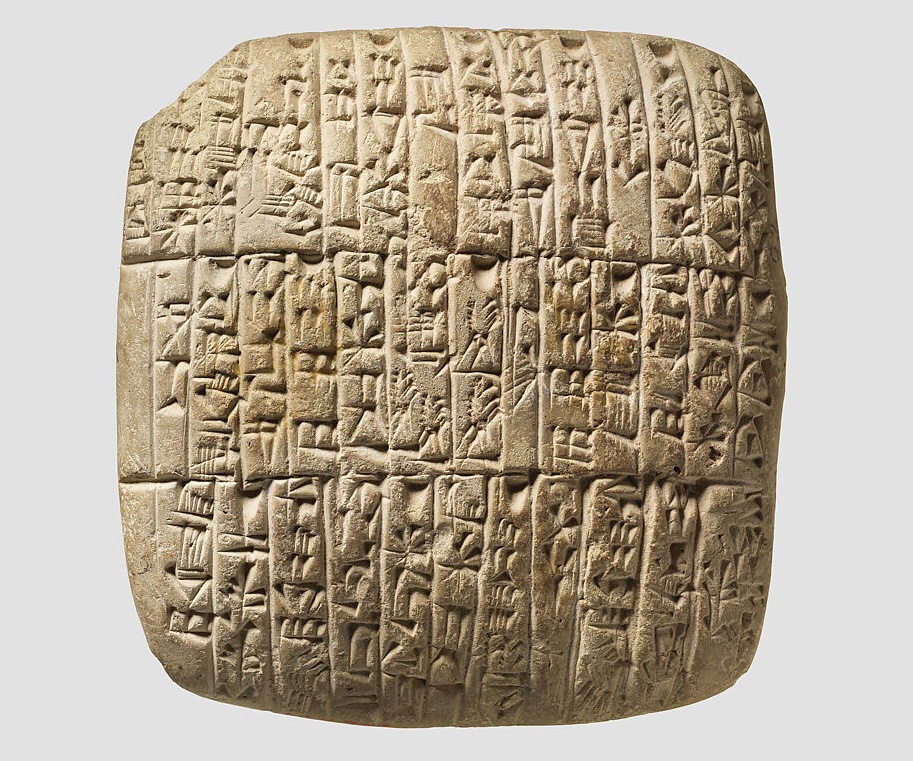 Akkadian (Mesopotamia) clay contract capturing a house sale, 2350-2150 BCE, image from The Metropolitan Museum of Art
Around 1750 BCE in Babylon, two people making a deal didn’t shake hands and trust blindly. They went to a scribe. The scribe used cuneiform to press the terms into wet clay. Then the seals, small carved rollers, each one unique, were rolled into the surface. That seal was the signature.
That tablet, scribed with the terms of the agreement, was then wrapped in a second layer of wet clay, and the agreement text was duplicated on the outside. The inner tablet was sealed permanently inside; both the inside and outside tablets contained a copy of the same text. This is an ancient kind of cryptographic envelope. In a dispute, you broke the envelope and compared the two.
These clay tablets were not museum pieces. They lived in homes, temple archives, merchant family vaults. The Egibi family of Babylon kept a private archive spanning something like a hundred and fifty years and thousands of tablets, a banking and trading operation recorded across generations. Commercial loans, worker hire, land lease, apprenticeship, and even marriage and adoption; ordinary commercial life was documented constantly, and was the default expectation.
Centuries on, a different empire, and a different toolkit for the same problem. Across a wide stretch of the Ottoman world, every significant town had a kadı; a state-appointed judge, notary, and record-keeper combined in one role. People came routinely, to get ordinary transactions into the court’s bound register, the sicil. Parties attended in person, their agreement was spoken aloud, the were witnesses confirmed, a scribe entered it, the the kadı issued a hüccet - a certified copy - which you took away as your proof-of-record.
This was a durable, public, third-party register that created trust between strangers who otherwise wouldn’t transact. It let people who didn't share a legal framework act as if they did. That's the technology that made cross-communal commerce workable in the Ottoman world, and it’s the technology that’s been missing from most of the modern digital economy, despite our databases, dashboards and PDFs.
In the world of the internet and AI agents acting on behalf of humans, a shared framework of trust becomes vital. We're about to understand what that means, for good or bad.
What Agreebase actually is
Agreebase is the modern version of a notary layer to public life. Its job is to create an irrefutable record that specific parties, controlling specific verified contact points which together comprise an identity, agreed to, or attested to, specific words at a specific moment in time.
It doesn't give legal advice. It's a trusted intermediary whose job is to take the moment of agreement and press it into a permanent record.
Agreebase is built around three types of record:
Agreement. Two or more parties confirm an agreed body of text. This is essentially a mini contract for everyday life. A loan, freelance terms, or a partnership understanding between founders before there’s a company, a round, or general counsel. There's no reason a contract under 350 words can't support the vast majority of day-to-day agreements.
Declaration. One party attests to something. A receipt, record of intent, personal commitment, or formal disclosure. A journalist or whistleblower’s contemporaneous note of what was known and when, proof that you had an idea before it appeared anywhere else; the sort of thing that matters later and is useless if it only lives in your head.
Notarisation. A party attests that a digital file, or body of text, already exists in a specific form at a specific moment. A signed PDF that arrived from elsewhere. A piece of creative work whose provenance will matter at a later date. A report, photograph or video, a will. Something you need to be able to point at and say that this file, or this text, existed in this shape at a certain point in time.
When a record is finalised, four things happen. A confirmation email goes to every party, with the full record included. A transaction is written on the Base blockchain with the cryptographic hashes that lock the record in time, and cannot be changed later, by anyone. A signed PDF is generated. Visual identicons are produced for each party and for the record itself.
That confirmation email is the tablet, and it comes with the metadata that a party, or court or arbitrator, can later verify by recreating the hash and comparing it with the one written by Agreebase into the permanent blockchain.
Your identity is your signature
The Babylonian cylinder seal was a form of distributed identity infrastructure. It worked because it was a physical object you had and other people didn’t. Writing a contract into clay was the binding act. Possession of the tablet was proof that it belonged to you.
Most modern e-signature systems lean on legal fictions like a typed name or a checkbox.
Agreebase takes a different approach to signatures, which we call proof-of-control. Most people already control several digital accounts that bear your identity in some form or another, and this is even moreso as governments try to eradicate digital anonymity. Email, Telegram, an X handle, a GitHub profile, a Reddit account. Those platforms have already spent significant money and time figuring out who their users are, because they have to. The identity work has already been done, and Agreebase piggybacks off that to allow you to use your existing digital identity as a legally defensible signature.
To sign with your X account, you post a unique challenge string as a post or comment. The same with Reddit. To sign with GitHub, you publish that unique challenge string as a public gist. With Telegram, you hit a deep link inside the app. Agreebase then checks that the unique challenge string was posted by your, and it keeps an audit trail of every one of those proofs of control. It does this without ever accessing those accounts; the assurance comes from the unique, cryptographically-generated text that Agreebase generates for you to post.
The digital identity, already yours, is the seal. Demonstrating control of that identity is the proof. Your identity is your signature, because you had to do something that only your online identity can do in order to approve of your identity being marked as a signature on a record.
A record anyone can check, forever
The clay envelope worked because the comparison was open. Break it, read and compare the inside against the outside. It either matches or it doesn't.
Agreebase tries to carry that principle forward. Once a record is sealed, its cryptographic hash is written to the Base blockchain. A blockchain exists across thousands of nodes, controlled by no single entity, so writing to that chain is an act that nobody can reverse. Anyone can take the text or document they believe was recorded and check it against the on-chain hash. Just one single character off and the hashes won't match.
The rules for reproducing the record are spelled out in the confirmation email parties get when signing via Agreebase. Anyone with the original content can check the record on their own long after Agreebase is gone. In our modern life, that kind of permanence is hard to come by.
Why now... The agent problem
AI agents are starting to act on behalf of humans and increasingly doing so with less human monitoring and intervention.
Agreebase is built partly so agents can transact on behalf of humans with a notarial record attached. An agent can create an agreement, make a declaration, or notarize a document through the same platform a human uses, with clear attribution of the agent and the human principal. What was done, by whom, on whose behalf, when, checkable by anyone, and permanent by design.
An agent, told it has permission to do something, can in seconds set up a declaration and have their human operator sign it, creating an immutable record of authorization.
The larger point
This isn’t, in the end, a technology story with a historical costume. It’s a very old story told in new materials.
Civilisations keep inventing ways to set agreements in stone. In the 21st century the clay becomes cryptographic. The seal becomes control of a verified digital identity. The register becomes a public blockchain. The scribe becomes software. The principle has been stubborn for four thousand years for a reason.
What Agreebase is trying to facilitate is something ordinary people have had in various periods and mostly don’t have now: a trusted, durable, verifiable place to record the small and large agreements that make up an ordinary life. The ability to record an agreement in time made possible, for a world that runs on inboxes, PDFs, and, increasingly, machines acting in our name.
That’s the idea behind Agreebase.
Get in touch
Agreebase was created by @CuriousLuke93x who can be contacted on X or by email at luke.cohen@citation.al.